
Engineered Strength.
From the Surface Within.
Heat treatment for precision gears. Hardness, wear resistance and toughness — matched to the material, geometry and operating demands of your application.
The Right Process.
The Right Performance.
Heat treatment is a critical part of gear manufacturing and can substantially affect tooth hardness, wear resistance, fatigue strength, toughness and service life. The appropriate process depends on the gear material, size, tooth geometry, operating load, speed and required performance.
Global X Gears can manufacture gears with the heat treatment specified on the customer’s drawing or recommend an appropriate treatment for review where performance requirements rather than a specific process are provided.
Carburising and Case Hardening
Carburising is widely used for heavily loaded gears manufactured from low-carbon alloy steels such as 20CrMnTi, 20Cr, 20CrMo and 20CrNiMo. The gear is heated in a carbon-rich controlled atmosphere so that carbon diffuses into its surface. It is subsequently quenched and tempered, producing a hard outer case while retaining a tougher, more ductile core.
The principal benefit is the combination of high tooth-surface hardness and wear resistance with a tough, impact-resistant core. This makes carburising particularly suitable for spur gears, helical gears, spiral bevel gears, planetary gears, sun and planet gears, ring gears, gear shafts and pinions operating under high loads. Case depth and final hardness can be specified according to the application and customer drawing.
Carbonitriding
Carbonitriding is similar to carburising but introduces both carbon and nitrogen into the surface of the steel before quenching. It generally produces a relatively hard, wear-resistant case and can be particularly effective on smaller components where a shallower hardened layer is appropriate.
The process can improve surface hardness, wear resistance and fatigue resistance while retaining a tougher core. It is commonly suitable for smaller spur gears, helical gears, pinions, sprockets and other relatively small transmission components, particularly where good wear performance is required without a very deep hardened case.
Nitriding
Nitriding introduces nitrogen into the surface of suitable alloy steel at a temperature below that normally used for carburising. Unlike conventional carburising, the process does not normally require subsequent quenching. This can significantly reduce dimensional movement and distortion during heat treatment.
Nitriding produces a very hard, wear-resistant surface with good fatigue resistance while allowing the gear to retain a strong core. The relatively low distortion makes it particularly useful for precision gears, gear shafts, splines, worm shafts, helical gears and other components where dimensional accuracy after heat treatment is important. It can also be advantageous for components that are difficult or expensive to finish-machine after hardening.
Induction Hardening
Induction hardening uses an electromagnetic field to heat selected areas of the gear rapidly. Once the required temperature is reached, the heated area is quenched to create a hardened surface layer. Because heating can be concentrated around the gear teeth or other selected surfaces, the remainder of the component does not necessarily undergo the same degree of hardening.
The process provides good surface hardness, wear resistance and tooth strength while retaining a tougher core. It is particularly useful for larger spur gears, helical gears, gear racks, sprockets, pinions and ring gears, especially where full carburising of a large component may be unnecessary or uneconomical. Localised treatment can also be advantageous for large gears where only the working tooth surfaces require increased hardness.
Through Hardening — Quenching and Tempering
Through hardening is generally applied to medium-carbon and alloy steels such as 40Cr, 42CrMo and 45 steel. The complete component is heated to its appropriate hardening temperature and quenched, followed by tempering to obtain the required balance between hardness, strength and toughness.
Unlike case hardening, the objective is not to create a very hard outer case over a softer core. Instead, the treatment develops mechanical properties through a substantial proportion of the component. It is suitable for spur gears, helical gears, gear shafts, pinions, racks, sprockets and many general industrial gears where high overall strength and toughness are more important than an extremely hard carburised tooth surface.
Normalising
Normalising involves heating steel above its critical transformation temperature and then allowing it to cool in air under controlled conditions. The process helps refine the grain structure and produces more uniform mechanical properties throughout the component.
For gear manufacturing, normalising is frequently used as a preliminary treatment before machining or subsequent heat treatment, particularly for forgings and larger gear blanks. It can improve material uniformity, machinability and dimensional stability. It is therefore applicable to large gear blanks, ring gears, gear shafts, racks and heavy industrial gears before final machining and hardening.
Annealing
Annealing involves heating the material to a specified temperature followed by controlled, generally slow cooling. Its purpose is normally to soften the material, relieve internal stresses and improve machinability rather than to produce the final working hardness of the gear.
Annealing can be particularly useful before machining large gears, gear blanks, shafts, ring gears and components manufactured from harder alloy steels. By improving machinability and reducing residual stresses from previous forming or processing operations, it can provide a more stable material condition before precision gear cutting and subsequent final heat treatment.
Stress Relieving
Stress relieving heats a component to a controlled temperature below the transformation range and holds it for a specified period before controlled cooling. Its primary purpose is to reduce residual stresses introduced by forging, casting, welding, rough machining or previous manufacturing operations.
For gears, reducing these internal stresses can improve dimensional stability during subsequent precision machining and heat treatment. Stress relieving can be particularly valuable for large-diameter gears, ring gears, gear racks, long gear shafts and heavily machined components, where distortion could otherwise affect tooth geometry, concentricity or final dimensional accuracy.
Flame Hardening
Flame hardening uses a controlled high-temperature flame to heat selected surfaces rapidly before quenching. Like induction hardening, it allows specific working areas to be hardened without necessarily heat treating the entire component.
The process can provide a hard, wear-resistant tooth surface while retaining a tougher underlying structure. It can be particularly appropriate for large gears, large gear racks, sprockets and heavy industrial components where localised surface hardening is required and the component size may make other processes less practical.
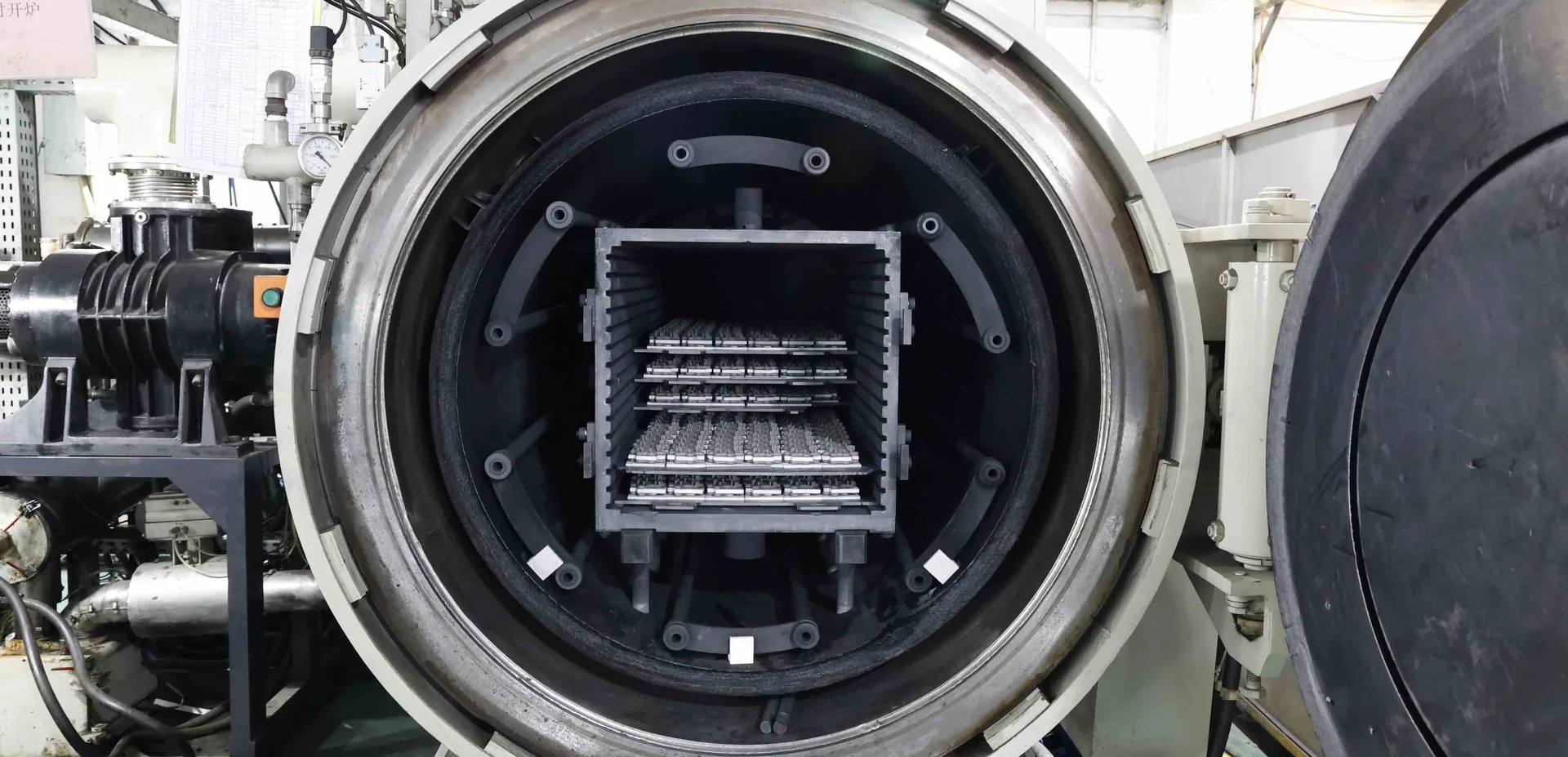
Vacuum Heat Treatment
Vacuum heat treatment is performed in a controlled low-pressure environment with minimal exposure to oxygen. Depending upon the material and specification, the process can include hardening, tempering, annealing and other thermal treatments.
An important advantage is the ability to produce clean surfaces with reduced oxidation and controlled processing conditions. It can therefore be suitable for high-precision gears, specialised alloy-steel gears, gear shafts and components where surface condition, dimensional control and repeatability are particularly important.
Cryogenic Treatment
Cryogenic treatment is a supplementary process rather than a replacement for conventional hardening. Following heat treatment, components are cooled to very low temperatures under controlled conditions and subsequently returned to ambient temperature, normally followed by an appropriate tempering operation.
For selected steels and applications, cryogenic processing can improve dimensional stability and wear performance by completing metallurgical transformations that may remain after conventional quenching. It may be specified for high-precision or particularly demanding gears and tooling applications, but is not normally required for general industrial gears.
Selecting the Correct
Heat Treatment
There is no single heat-treatment process suitable for every gear. Selection depends upon factors including steel grade, gear size, tooth geometry, transmitted torque, operating speed, shock loading, wear requirements, required case depth, surface hardness and permissible distortion.
For customer-designed gears, Global X Gears will manufacture to the material, heat-treatment specification, hardness and case-depth requirements shown on the customer’s drawing. Where these have not been specified, the application and operating requirements can be reviewed before the manufacturing route is agreed.
Important: Heat-treatment specifications should define the applicable standard and, where relevant, required surface hardness, core hardness, effective case depth and permitted hardness range. Final requirements should be confirmed against the customer’s engineering specification before production.
Start a Conversation
Let’s Discuss
Your Heat Treatment Requirements
Send your drawing or specification and we will review the material, hardness and case-depth requirements with you before quotation.